GENERAL INQUIRIES
info@forward.oneMARKETING INQUIRIES
media@forward.oneINVESTOR RELATIONS
ir@forward.oneThe Power Law is the math that governs venture capital. If you want to play in this arena, you have to build for it.



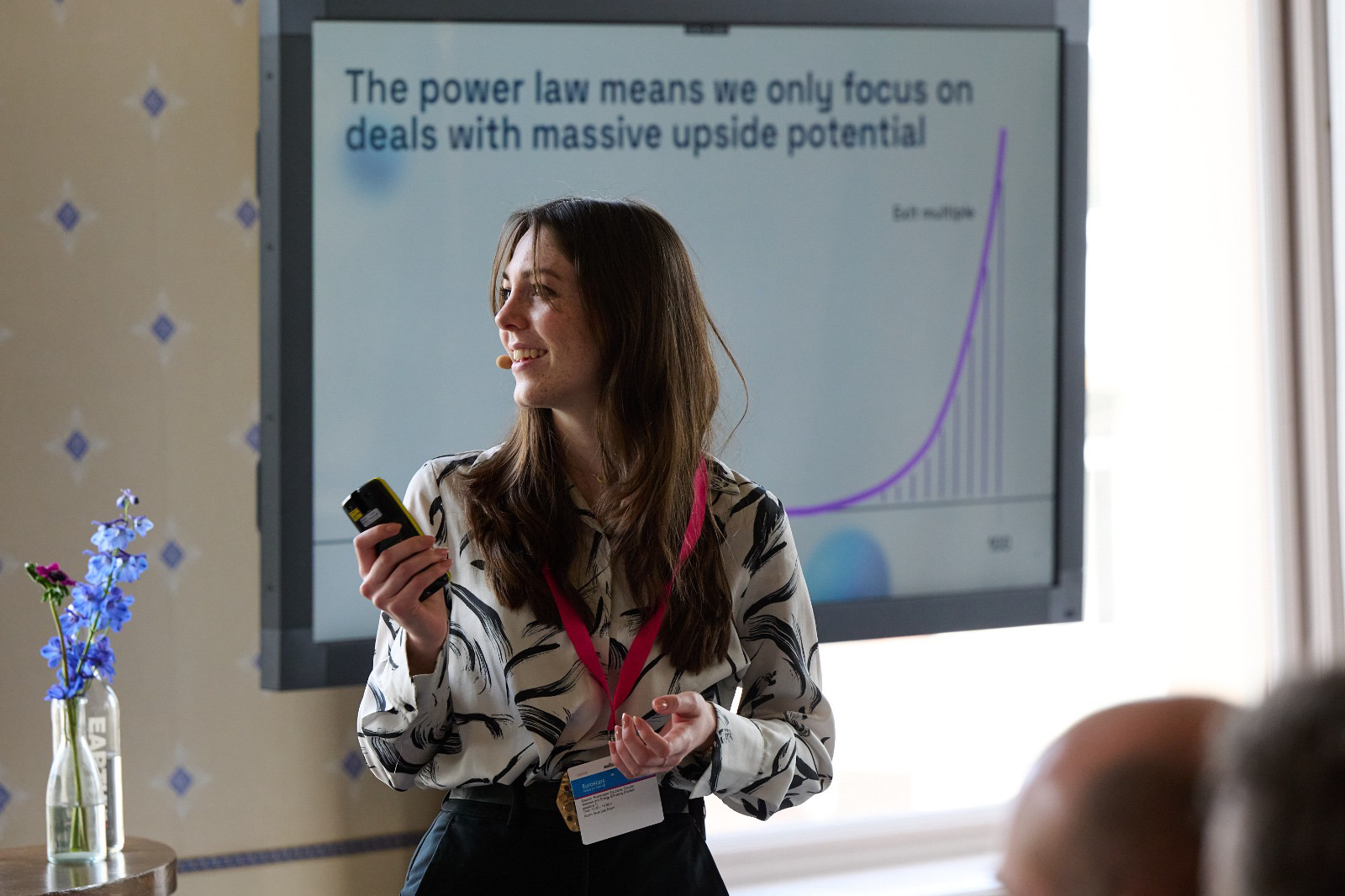
By Cailin Greiner, Investment Manager at FORWARD.one
I spend most of my week talking to founders who are building seriously impressive technology. Many of them think venture capital is about convincing investors their company is “good”: good product, good traction, good team.
Here’s the problem: in venture, good doesn’t move the needle.
When you hear VCs talk about “big markets,” “defensibility,” and “scalability,” it can sound like jargon. It isn’t. It’s how we survive the Power Law. This is the brutal rule that says only a handful of companies will generate almost all of the returns in a fund.
If you want to play this game, you need to understand that rule and build for it.
In venture capital, outcomes are not evenly distributed. They’re wildly skewed.
This is the Power Law: a tiny fraction of companies generate almost all venture returns. According to Dealroom, just six VC-backed companies founded since 1990 — the top 0.003% — have produced 46% of realized value, while the top 2% account for 89%.
The flip side is just as brutal. Around 70–75% of venture-backed startups never return capital. Most of the rest don’t move the needle. One breakout company can return an entire fund. Two or three can make the difference between a top-performing fund and a forgettable one. The rest barely register in the numbers.
That means:
It’s not cruelty. It’s math.
That’s why I don’t just ask, “Is this a good company?”
I ask, “Could this realistically be one of the few that carry the fund?”
To answer that, I drill into a few things very fast:
This logic also shapes how we deploy capital. At FORWARD.one, our strategy is explicitly designed to optimise for the winners. We invest small at the earliest stage to earn the right to learn. Then we double or even triple down when the data, execution, and momentum show us who has the potential to be an outlier.
Write-offs will happen. We don’t pretend otherwise. What is within our control is how much capital we continue to allocate to companies that won’t break out. The Power Law isn’t about avoiding failure. It’s about concentrating conviction once the signal becomes clear.
I love deep tech. I’m currently digging into grid flexibility, autonomous systems, underwater security, and a few things I probably shouldn’t put in writing yet.
But here’s the pattern I see again and again:
Most deeptech founders overbuild the product and underbuild the commercial machine.
They assume “if the tech is great, the market will come.” It won’t.
Under the Power Law, the gap between good and great is massive, and almost always commercial:
One of the first things I look for in a founder is a sales mindset.
You can feel it in the first five minutes of a call:
That mindset shows up everywhere: in how they run early pilots, negotiate pricing, build their first processes, and pitch to investors and talent later on.
Outliers are brutal in execution. If you ignore commercial execution, you’re not in the Power Law game. You’re building a good small business. There’s nothing wrong with that, but it’s not what venture capital is designed to fund.
If you want to raise venture capital, you need to design for outlier potential from day one. Here’s where I’d start.
If your market can’t sustain a €100M+ revenue line, it will be very hard to be a fund-returner.
That doesn’t mean you must be in a buzzword category. It means you either:
If you’re in a cramped niche and hoping to “grow out of it later,” that’s a red flag.
If a customer can’t quickly repeat back why you matter, you don’t.
Your solution should sit in their top three priorities, not in the “nice to have” bucket that gets postponed every quarter. The best founders I work with can explain the pain, the urgency, and the ROI in one or two sentences, without slides.
I want to see the outline of a machine:
Founders who treat sales as a craft usually raise better, hire better, and scale faster. They also handle board conversations more confidently, because they’re tracking the right things.
Outliers win because others can’t easily copy them and outspend them.
Defensibility can come from many places:
What matters is that the more you win, the harder you are to dislodge. If success just invites a dozen clones, the Power Law will not be kind to you.
Speed is underrated. Serious speed is a competitive advantage.
I pay attention to how fast founders:
Momentum compounds. Hesitation kills.
Choosing a potential winner is only the start. Optimising the chance of an outlier also requires a lot from the VC.
At FORWARD.one, our work doesn’t stop after the first check. When we see potential, we actively help founders move faster and aim higher. A big part of that is commercial execution. We use our network to open doors to customers, help sharpen pricing and sales motions, and support founders in turning early traction into something repeatable.
Just as important is being willing to be bold. We’re not afraid to push for ambitious outcomes when the signal is there. Our role is to help founders think bigger, move faster, and execute with conviction. The Power Law doesn’t reward playing it safe. It rewards teams who commit fully when the opportunity is real.
The Power Law is the math that governs venture capital.
If you want to play in this arena, you have to build for it.
Good isn’t good enough.
Not for your customers.
Not for your team.
Not for the LPs who trust us to allocate their capital into the very few companies that can truly move the needle.
The quality of your team is everything. Work with the most ambitious outcome in mind. Ask yourself honestly: Is this the team that could take us to IPO in six years? If the answer is no, fix that first.
Set yourself up for success from day one with the right people, the right ambition, and a company built for the Power Law, not for comfort.